



ABOUT ASPG
Established in 1978, the Australasian Study of Parliament Group is a politically non-partisan body, focused on encouraging and stimulating research, writing, teaching and discussion about parliamentary institutions, particularly those of Australia, New Zealand and the South Pacific.
The ASPG has a main Executive body and has established Chapters in all States and Territories of Australia and in New Zealand. These Chapters are supported by the institutions providing secretariat services to the respective legislatures in Australia and New Zealand.
ASPG membership consists of parliamentarians, parliamentary officers, academics, teachers, journalists, students and other interested individuals.
SPRING/SUMMER 2025 • VOL 40 NO 2
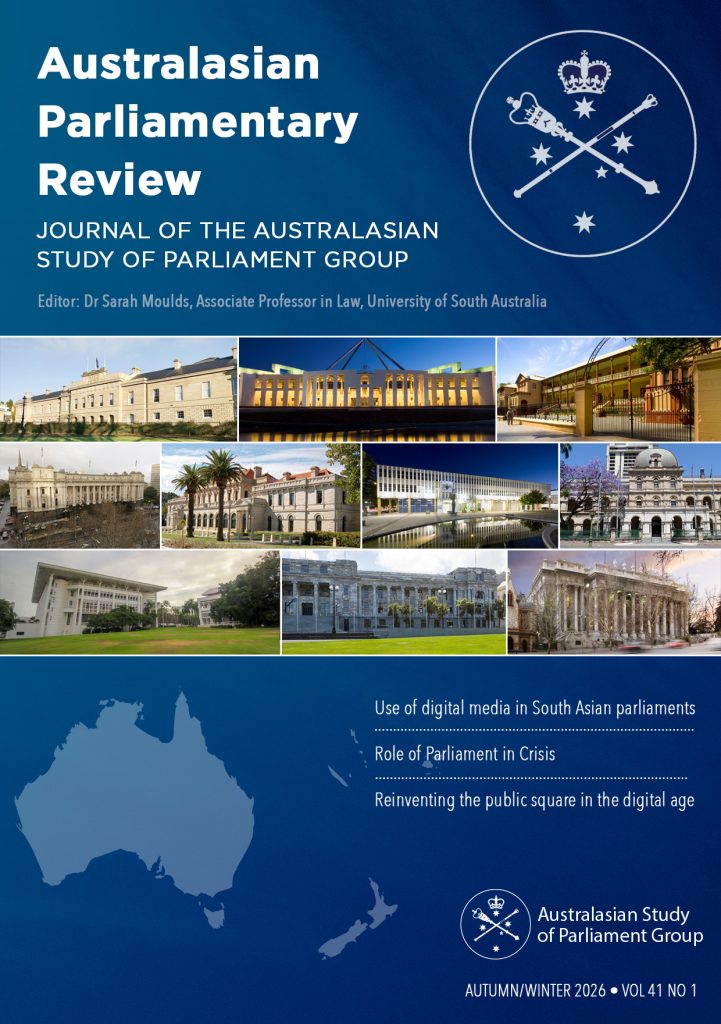
It is with great pleasure that I introduce Volume 41, Number 1 of the Australasian Parliamentary Review. This edition brings together a diverse collection of scholarship that reflects the journal’s enduring commitment to understanding parliamentary institutions as they operate in practice—across Australia and the wider Australasian and Indo-Pacific region.
A defining feature of this issue is its strong engagement with practitioner-informed perspectives, both from within Australian parliaments and from contributors working in, or closely observing, parliamentary systems beyond Australia. At a time when legislatures across the region are grappling with democratic stress, rapid technological change and shifting community expectations, these voices provide critical, grounded insights into how parliaments respond to contemporary challenges.
The issue opens with a Case Note by Sue Hunt, analysing the New South Wales Court of Appeal decision in Ward v Hoenig. Against the backdrop of rare contemporary consideration of parliamentary expulsion powers, Hunt examines the scope, purpose and justiciability of the NSW Legislative Assembly’s authority to expel a member. Her careful legal analysis highlights the ongoing relevance of parliamentary self-regulation, evolving standards of member conduct, and the continuing importance of exclusive cognisance in delineating the relationship between courts and parliaments.
The Articles section begins with a peer-reviewed comparative study by Md. Iqramul Haque and Nurul Huda Sakib, examining the use of digital media in South Asian parliaments. Drawing on web-based analysis across multiple jurisdictions, the authors offer an important regional perspective on parliamentary digitalisation, transparency and communication with citizens — an area of growing significance for parliaments throughout the Indo-Pacific.
A further regional contribution comes from Malindu Bathiya Wickramasingha Weerakkody, who examines the role of Sri Lanka’s 9th Parliament (2020–2024) during an unprecedented convergence of political, economic and international crises. Using Hansard analysis and a neoclassical realist framework, the article provides a sobering account of parliamentary marginalisation in a context of executive dominance, with broader implications for crisis governance and legislative resilience in hybrid democracies.
Several articles then return the focus to Australian parliamentary practice, particularly at the intersection of democracy and technology. William Coad explores the transformation of public deliberative spaces from the agora to algorithmic platforms, while Robin Howlett examines online publication and the accessibility of parliamentary information, drawing on the experience of the New South Wales Legislative Council. Charlotte Lever addresses citizen engagement in parliamentary budget oversight, arguing for the integration of more participatory and deliberative approaches in Australian parliaments, informed by comparative
international experience. The issue concludes with book reviews by David Clune and Bruce Kingston, revisiting the political legacies of Paul Hasluck and Malcolm Fraser.
I extend my sincere thanks to all contributors and reviewers for their thoughtful scholarship and, in particular, for the depth of insight that practitioner experience — both Australian and regional — brings to this volume.
I extend my sincere thanks to all contributors and reviewers for their thoughtful scholarship and commitment.
Dr Sarah Moulds, Associate Professor in Law, Adelaide University
May 2026
Our Chapters




Join ASPG - become a member!
The ASPG provides an outstanding opportunity to establish links with others in the parliamentary community.
Membership may include:
Subscription to the ASPG Journal Australasian Parliamentary Review
Concessional rates for the ASPG Conference
Participation in local Chapter events